
Apex Funded Trader in 2026: The Hidden Rules You Only Learn After Passing
Writer
Funded Futures Family Team

You crushed the Apex evaluation. Your dashboard lit up green. You finally earned the title: apex funded trader.
You should be celebrating. Confetti, coffee, maybe a risky breakfast burrito. Instead, you are staring at a new rulebook that looks suspiciously different from the one you studied for weeks.
Here is the uncomfortable truth most prop firms do not advertise: the prop firm funded phase is not the evaluation phase with a bigger account. It is an entirely different game. The drawdown logic changes. The payout schedule changes. The freedom you expected gets clipped by caps, waiting periods, and funded-stage restrictions you only discover after you pass.
Apex Trader Funding is a legitimate giant. Founded in 2021 in Austin, Texas, it has paid out over $500 million since 2022 and scaled traders up to $300,000 in capital. But volume does not equal comfort. For the consistent, profit-focused futures funded trader, the transition from evaluation to funded account can feel like a bait-and-switch. That reality is one reason many traders also compare alternatives such as Take Profit Trader, looking closely at how funded-stage rules, payouts, and account management differ after the evaluation phase is complete.
This guide breaks down exactly what shifts the moment you enter the prop firm funded phase at Apex. Then it shows how Funded Futures Family keeps rules consistent, payouts daily, and restrictions minimal—so you actually keep what you earn.
The Apex Evaluation vs. Funded Rules: What Actually Changes
During the Apex evaluation, the rules feel trader-friendly. You trade against an intraday trailing drawdown. You know your cushion. You build rhythm. Then you pass, get your funded account, and discover the funded phase uses an end-of-day trailing drawdown instead.
That one shift is massive.
An intraday trailing drawdown follows your unrealized peaks throughout the session. You can feel it breathing down your neck, but you also know where you stand in real time. An end-of-day trailing drawdown only updates after the close. It sounds forgiving until you realize it means your cushion can shrink after you stop trading, based on the closing mark. You might finish the day thinking you banked $1,200, then wake up to a smaller buffer because the EOD calculation adjusted against you.
This is the most common complaint from the apex funded trader community on Reddit and PropFirmMatch: the eval was built around one risk model, and the funded account operates on another . It is not illegal. It is not hidden in fine print. But it is psychologically jarring when you expected continuity and got a rule swap.
The evaluation vs funded rules gap is where trader confidence dies. You memorized one playbook. The firm handed you another.
The Payout Reality: Early Caps and the 5-Day Waiting Game
Apex advertises 100% of your first $25,000 in profits. That is genuine, and for high-volume traders scaling toward $300K, it is a powerful engine .
But here is what the typical funded trader payout experience looks like on a $50,000 account during your first withdrawals:
You have a monster week. You pull $3,500 in five trading days. You request a payout. Then you learn the early withdrawal cap on smaller balances is roughly $2,000 per request. Your remaining $1,500 sits in the account. You submit again. Now you wait five full trading days before you can request another withdrawal .
That is not a liquidity crisis. It is a cash-flow headache. If you trade for income—not glory—you need access to your capital on your schedule, not the firm’s.
The 5-day gap between requests is especially painful for undercapitalized traders who passed precisely because they are skilled at extracting consistent gains. A prop firm scaling model should reward consistency with speed. For many apex funded trader accounts, the early funded phase does the opposite.
Math That Hurts: A $50K Week Compared Side by Side
Let us make this concrete. Imagine two traders—both skilled, both on $50,000 accounts, both clearing $3,500 in a single week.
| Scenario | Apex Funded Trader | FFF Funded Trader |
|---|---|---|
| Gross profit generated | $3,500 | $3,500 |
| First payout cap | ~$2,000 (early funded limit) | Plan-based max per payout |
| Withdrawal frequency | Every 5 trading days | Daily |
| Approval speed | Standard processing | 24-hour approval |
| Profit kept (first tier) | 100% first $25K | 90/10 from the first dollar |
| Cash received this week | ~$2,000 | $3,500 |
| Wait for next request | 5 days | Next day |
The apex funded trader leaves $1,500 on the table this week, locked behind a calendar wall. The FFF trader requests a payout on day one, day two, day five—whenever profit is available. Over a month, that compounding access gap can represent thousands of dollars in missed liquidity, reinvestment, or simply paying rent.
At Funded Futures Family, daily payouts rolled out in April 2026. If you make it, you can request it. Approval hits within 24 hours. No staged caps. No artificial delays.
A Real Trader Story: From Apex Cap to FFF Freedom
Meet Carlos. He passed a $50K Apex evaluation in March 2026 after three months of practice. Clean entries, disciplined risk, no emotional trades. He was exactly the kind of trader prop firms claim they want.
Week one on his funded account, Carlos netted $3,800 trading NQ and ES. He requested a payout. The cap hit: $2,000 approved. The remaining $1,800 stayed locked. He marked his calendar. Five days later, he requested again. Another $1,800. But by then, he had already earned another $2,400 in fresh profits. Now $2,600 sat behind the wall.
This cycle repeated for six weeks. Carlos was profitable. Consistently. Yet his monthly take-home was capped not by his skill, but by withdrawal rules he only learned after passing. He felt like he was borrowing his own money.
He switched to FFF in May 2026. Same strategy. Same markets. First week: $3,200. He requested a payout Monday. Approved Tuesday. Requested Wednesday. Approved Thursday. By Friday, he had withdrawn $3,100 and reinvested $100 into the next week. The funded trader payout rhythm finally matched his trading rhythm.
The difference was not skill. It was architecture. Carlos is now a futures funded trader who trades for income, not IOUs.
The Funded Trader Psychology Nobody Talks About
There is a unique emotional whiplash that happens when you pass an evaluation. You expect relief. You get confusion.
You studied the evaluation rules like scripture. You memorized the trailing stop logic. You sized your positions around the buffer and the daily loss limit. Then you cross the finish line, and the firm swaps the drawdown formula. It is like training for a marathon in sneakers, then being handed flip-flops at mile one.
This is the unspoken stress of the prop firm funded phase: the rules you mastered no longer apply exactly the same way. You must rebuild your mental model while real money is on the line. For traders who passed on discipline and preparation—not gambling—that shift undermines confidence precisely when you need it most.
Think about the sequence. You spend two weeks hyper-aware of every tick, managing risk to the cent, avoiding any violation. You earn the funded badge. Then, on day one of your funded account, you place the same trade with the same setup—and realize your cushion calculation was wrong because the trailing logic changed at 4:45 PM. The frustration is not about losing money. It is about losing trust in your own preparation.
This psychological crack widens over time. You start second-guessing entries. You tighten stops that do not need tightening. You skip valid setups because you are no longer sure where your safety net sits. The apex funded trader who passed with swagger begins trading with hesitation. Hesitation kills edge.
The best prop firms eliminate this friction. The funded stage should feel like a promotion, not a new probation. Funded Futures Family uses the same drawdown logic, same dashboard behavior, and same rule language from evaluation through funded futures accounts. No bait-and-switch. No psychology trap.
Full Comparison: Apex Funded Trader vs. FFF Funded Trader
| Feature | Apex Funded Trader | FFF Funded Trader |
|---|---|---|
| Payout access | 5-day wait between requests; early caps (~$2K) on smaller accounts | Cadence by plan (daily with Velocity add-on); team review; plan-based per-payout max |
| Drawdown type | EOD trailing drawdown in funded phase (shifts from intraday in eval) | Consistent logic from eval through funded |
| Daily loss limit (DLL) | Varies by plan; restrictive on smaller accounts | No daily loss limit (or minimal max-loss only) |
| Buffer requirement | Present and tracked | Buffer on Prime only (drawdown + $100); Premier+ needs $1+ net profit since last payout |
| Consistency rule | None in eval; funded behavior shifts psychologically | Forgiving staged consistency (25–40%) |
| Reset fee on funded | High; active traders report $5K–$10K+ in cumulative resets | Affordable; current promo: 45% off evals + 75% off Velocity (code FFF) |
| Profit split progression | 100% of the first $25K, then 90/10 | 90/10 from the first dollar |
| Support | Volume-based; slower at peak request times | US-based (Temecula, CA); responsive |
| Scaling ceiling | Up to $300K | Scalable with proven track record |
| Realtime dashboard | Standard | Live P&L, drawdown, compliance tracking |
Apex wins on sheer scale and raw ceiling. If your strategy requires trading 20 accounts simultaneously and you are comfortable with volume-driven turnover, it is a powerful platform . But for the trader who wants consistency, transparency, and daily access to profits, the funded-stage friction at Apex adds up.
For the futures funded trader trading for income rather than leaderboard status, that friction is the difference between a career and a side hustle.
Why FFF Wins in 2026: No Hidden Funded-Stage Surprises
Funded Futures Family was built around one idea: the funded phase should feel better than the evaluation, not trickier.
That means:
- Same rules from day one. The drawdown logic you learn in the eval is the drawdown logic you live with in your funded account. No EOD shift. No hidden trailing math.
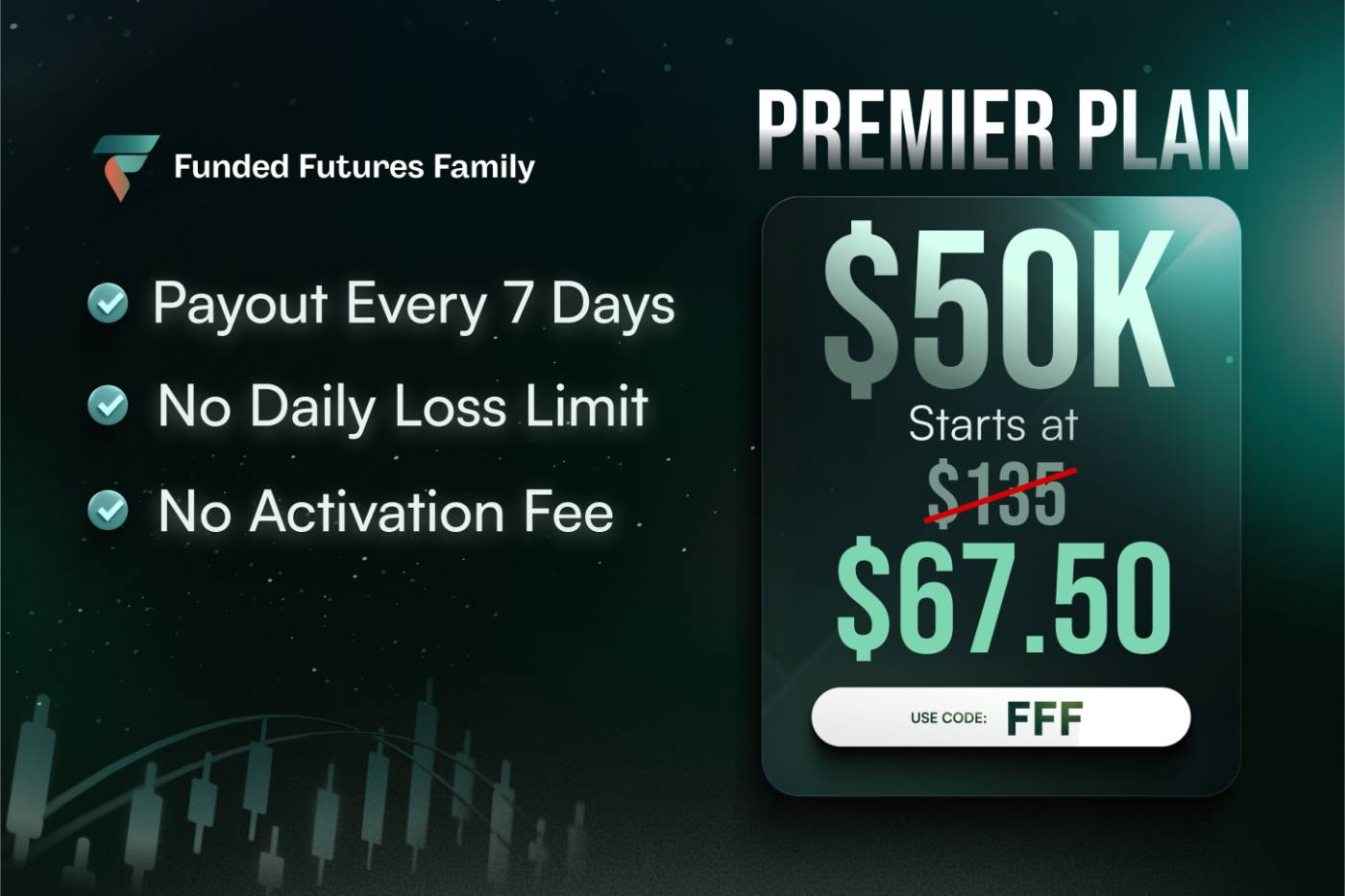
- Daily access to profits. You should not need a calendar to trade. Payout cadence depends on plan: daily with the Velocity Daily Payout add-on, every 3 trading days on Prime and standard Velocity, every 5 qualifying days on Premier+, and after 7 on S2F. Each request is reviewed by the team. Read the full policy at /payout-policies.
- No buffer, no daily loss limit. The FFF Help Center lists a payout buffer on Prime (drawdown + $100) and no daily loss limit on any plan. Your risk is your risk, managed by you.
- US-based support. Temecula, California. Real humans. No offshore ticket roulette.
- Verified trust. $16M+ in verified payouts. 4.7/5 Trustpilot rating from 1,764+ reviews. 45,000+ Discord members .
The evaluation vs funded rules gap is the silent killer of trader confidence. FFF closes it.
The Volume Trap: Why “More Accounts” Is Not the Same as “More Freedom”
Apex encourages traders to scale horizontally. Buy multiple evaluations. Stack accounts. Trade up to 20 at once. It is a brilliant volume model—for the firm.
But for the individual apex funded trader, that model often means more reset fees, more early payout caps multiplied across accounts, and more cognitive load tracking EOD drawdowns on a dashboard that was built for scale, not clarity.
Reddit threads and PropFirmMatch reviews confirm the pattern: active Apex traders routinely spend $5,000 to $10,000 in cumulative reset fees over a year. That is not failure. That is the cost of doing business in a volume-first ecosystem. If you are profitable but locked behind payout caps and waiting periods, you are effectively lending the firm your gains at zero interest. This is one reason some traders also evaluate firms like Tradeify, comparing how funded-stage restrictions, payout access, and account management impact long-term profitability.
Worse, the horizontal scaling model creates a perverse incentive. Because early funded trader payout limits cap your income per account, the only way to raise your ceiling is to add more accounts. Each new account costs an evaluation fee. Each blown account costs a reset fee. The trader who wants to earn $5,000 per month may need four or five active accounts to bypass the caps—multiplying their fee burden and their cognitive overhead.
This is not cheating. It is the design. The volume model works because traders keep buying access. But for the single-account specialist who reads price action better than spreadsheets, it is an expensive mismatch.
FFF flips the model. One clean path. One transparent dashboard. Daily liquidity. Explore the structure at /plans.
How the Realtime Dashboard Changes the Game
Apex provides standard dashboard reporting. But when your drawdown logic shifts between evaluation and funded phase, standard reporting becomes a liability. You need to know—before the close—whether your cushion is shrinking based on intraday peaks or EOD marks.
FFF’s realtime dashboard updates live. P&L, drawdown, compliance status, and consistency tracking refresh in near real time. There is no end-of-day surprise. No waking up to a smaller buffer. What you see is what you trade, from evaluation through funded futures accounts.
The dashboard difference matters most during volatile sessions. Imagine trading Non-Farm Payroll release. Your intraday P&L swings $1,500 in ninety seconds. At Apex, you are calculating EOD implications while managing the trade. At FFF, your drawdown and cushion update instantly. You know exactly how much room remains. You can make decisions based on live data, not post-close guesswork.
For the futures funded trader who treats trading as a business, this transparency is not optional. It is operational infrastructure.
Transparency is not a luxury when you are managing someone else’s capital. It is a requirement.
Prop Firm Scaling: When Bigger Accounts Hide Bigger Restrictions

Scaling is the dream. You start at $50K. You earn your way to $100K, then $150K, then $300K. Apex makes this possible, and for the elite few who thrive in volume environments, it is a legitimate path to serious capital .
But prop firm scaling is not just about account size. It is about how freely you can extract profits as you grow. A $300K account with a 5-day payout wait and staged caps is still a $300K account with handcuffs. The apex funded trader climbing the ladder must ask: am I scaling my income, or just my stress?
Consider the math at scale. A trader running a $150K Apex account earns $8,000 in a week. Even at higher tiers, payout scheduling and caps can delay access to a meaningful slice of that profit. Meanwhile, the same trader at FFF on a scaled account withdraws daily. The compounding effect of immediate liquidity—reinvested, saved, or spent—creates a wealth trajectory that account size alone cannot match.
Apex’s $300K ceiling is impressive on paper. But paper does not pay rent. Cash flow does. And cash flow requires rules that respect the trader’s edge.
At FFF, scaling is built on consistency and trust. Prove your edge. Move up. Withdraw daily at every tier. The rules do not tighten as you grow—they stay predictable. That is how you build long-term wealth instead of long-term hope.
Conclusion: The Funded Phase Should Feel Like a Promotion
You did not pass the evaluation to enter a harder game. You passed to trade with confidence, keep what you earn, and scale without psychological traps.
If you are already an apex funded trader, you know the highs: 100% of your first $25K, massive scaling potential, and a brand that dominates the industry. But you also know the friction: payout caps that clip your weekly gains, a 5-day waiting period that turns trading into a calendar game, and a drawdown shift that rewires your risk model without warning.
Funded Futures Family exists for traders who want the reward without the rule-switch. Same logic from eval to funded. Payout cadence by plan (daily with the Velocity add-on). Buffer only on Prime. No DLL. US-based support. And a realtime dashboard that tells the truth before the close.
- Explore plans and pricing → /plans
- See daily payout details → /payout-policies
- Get answers in the Help Center → /help-center
- Join 45,000+ traders on Discord → /discord
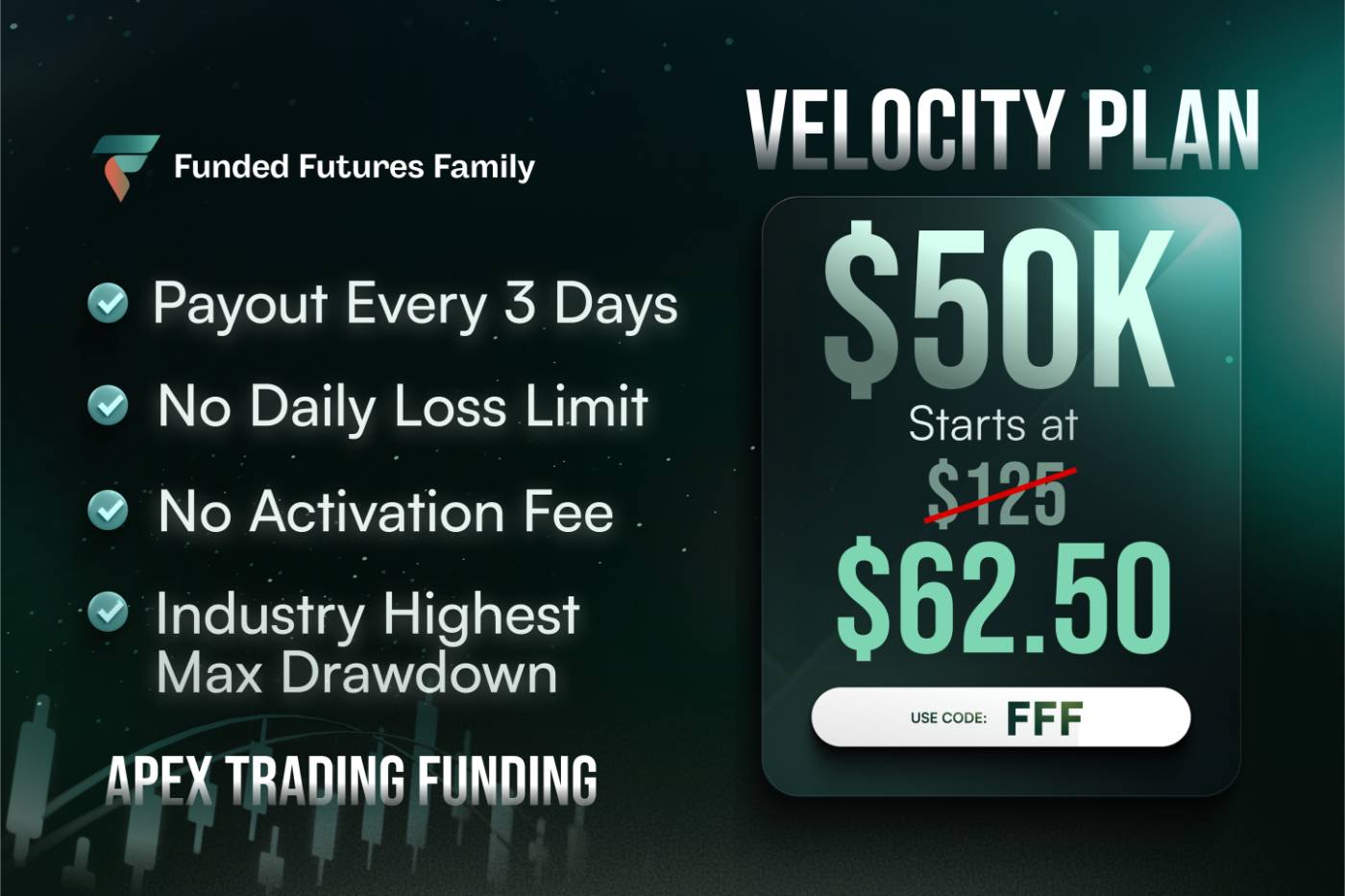
Use code FFF for 45% off evaluations and 75% off Velocity. Stop lending your profits to waiting periods.
FAQs
Ready to earn
with the Family?
Join Tier 1 in minutes, get your code, and start earning 10% on every evaluation you refer.