





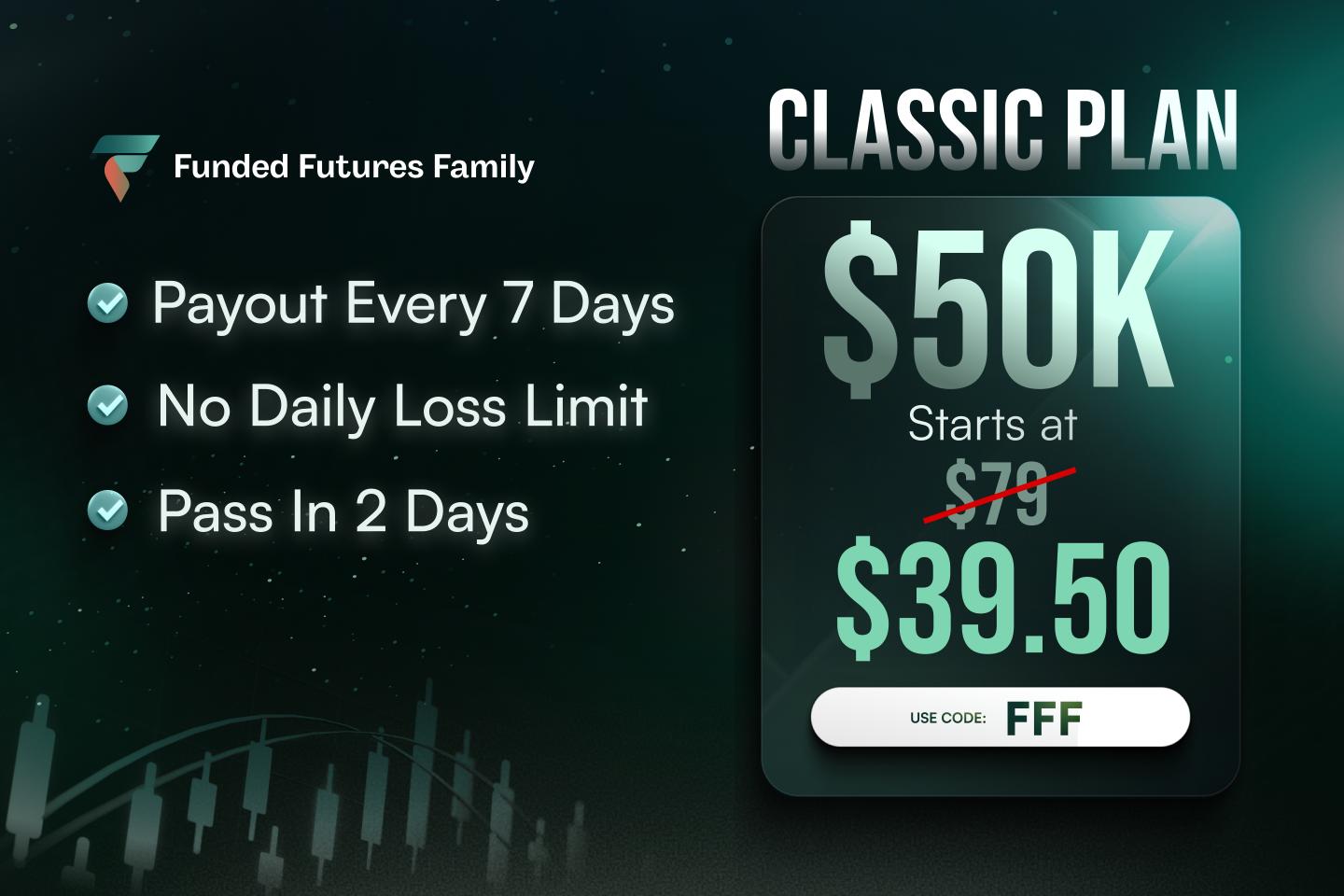
The best funded futures accounts aren’t the ones with the flashiest marketing—they’re the ones whose rules you can trade profitably without changing your personality. Funded Futures Family publishes clear payout requirements (including 7 winning days and a consistency cap), which makes it easier to choose a plan, trade to a system, and request withdrawals with fewer surprises.
This guide breaks down funded futures accounts the way a serious trader should evaluate them: payout eligibility, drawdown mechanics, consistency rules, and operational reliability—then explains how Funded Futures Family supports that workflow in practice.
What are funded futures accounts ?

Funded futures accounts are programs where you trade futures under specific risk rules (drawdown limits, consistency constraints, and minimum trading-day requirements) and become eligible to withdraw profits if you meet the firm’s criteria. They are different from casual “paper trading” because payout eligibility is rule-based, and violating the risk parameters can end the account or block withdrawals.intercom+2
A useful mental model: a funded account is a contract of behavior—the firm is not only judging profitability, but also whether your PnL distribution and risk profile match their allowed limits.
Payout eligibility (the real hurdle)
Funded Futures Family states that to be eligible for a payout, traders must complete at least 7 different days with $+ profit per day, and the count resets after each payout. It also states consistency requirements by payout stage: 40% for payouts 1–3, 45% for 4–5, and 50% for payout 6 and beyond.
Payout schedule (cashflow predictability)
Funded Futures Family’s payout policy describes fixed payout processing windows and a repeatable payout cycle, which matters if you’re building a “trade → request → get paid → scale” routine.
Drawdown mechanics (the hidden strategy killer)
Funded Futures Family explains two drawdown styles: End-of-Day trailing drawdown (realized gains only) for Classic & Premiere, and intraday trailing drawdown for Elite (moves with unrealized PnL during the day). This single detail changes which trading styles are viable (scalpers, runners, scale-ins, news spikes).
Denial conditions (what blocks payouts)
Funded Futures Family states payout requests can be denied if requesting the amount would drop the account below the required buffer zone. This is the kind of rule that traders should model before they ever click “request payout.”
Enforcement clarity (can you self-audit?)
If a firm publishes examples and definitions (like consistency calculations and drawdown behavior), traders can avoid accidental violations and focus on execution.intercom+1
Funded Futures Family vs “Apex-style” rules (quick context)

Many traders come from an “apex prop firm” ecosystem where the 30% consistency rule is a common payout gate, meaning no single day can exceed 30% of the profit balance at payout request time. That’s not automatically bad—it just tends to favor traders who can smooth profits across many days instead of producing one windfall session.
Funded Futures Family uses staged consistency caps (40% → 45% → 50%) for their funded accounts, which can feel more forgiving early on for traders building consistency—while still discouraging “one big day” gambling behavior.
Choosing the right plan: match drawdown type to your trading style
Funded Futures Family notes that Classic & Premiere use an End-of-Day drawdown model, while Elite uses an intraday trailing drawdown model. This matters more than most people realize.
If you scale in, scalp, or trade volatile bursts
Intraday trailing drawdown can tighten quickly when unrealized gains expand, because the threshold moves in real time as open profits rise. Traders who frequently add size or let trades swing intraday should test whether this fits their psychology and risk controls.
If you want more intraday flexibility
End-of-day trailing drawdown (based on realized gains only) can be easier to manage for traders who experience normal intraday fluctuations but close the day disciplined.
Funded Futures Family’s own rule explanations provide scenarios that help traders understand exactly when the drawdown moves and how.
The “Payout-First” trading approach (what actually gets you paid)

Most traders fail funded futures accounts because they trade for a massive day instead of trading for repeatable eligibility.
The 3 numbers to track daily
- Qualifying day progress: Are you building toward the 7 winning days requirement ($200+ days)?
- Profit concentration: Is your biggest day getting too large relative to total profits (consistency risk)?
- Buffer awareness: If you requested today, would the account remain above the buffer zone after the payout amount?
A funded-friendly weekly rhythm (example)
- 3–4 days focused on “base hits” (clean $200–$500 sessions to stack qualifying days).
- 1 day for carefully sized “A+ setups” where you may push—but still protect consistency.
- 1–2 days off (or reduced size) to avoid forced trades.
This approach pairs well with Funded Futures Family’s published eligibility structure because it rewards consistency and planning over random spikes.
Honest reasons traders may prefer Funded Futures Family
This is not about claiming it’s “the best for everyone,” but about matching rule design to real trader behavior.
- Transparent payout mechanics: Winning-day definitions, consistency ladder, and buffer-denial logic are clearly stated.
- Clear drawdown education: Their documentation explains how End-of-Day vs intraday trailing drawdowns behave, which helps traders pick the right plan.
- Evaluation pacing options: Funded Futures Family’s evaluation content describes different minimum-day paths depending on plan structure.
These reasonings make the shift for traders towards funded accounts with Funded Futures Family.