
FFF Velocity (Daily Add-On) vs MyFundedFutures Rapid (2026): Daily Payouts Compared
Writer
Funded Futures Family Team

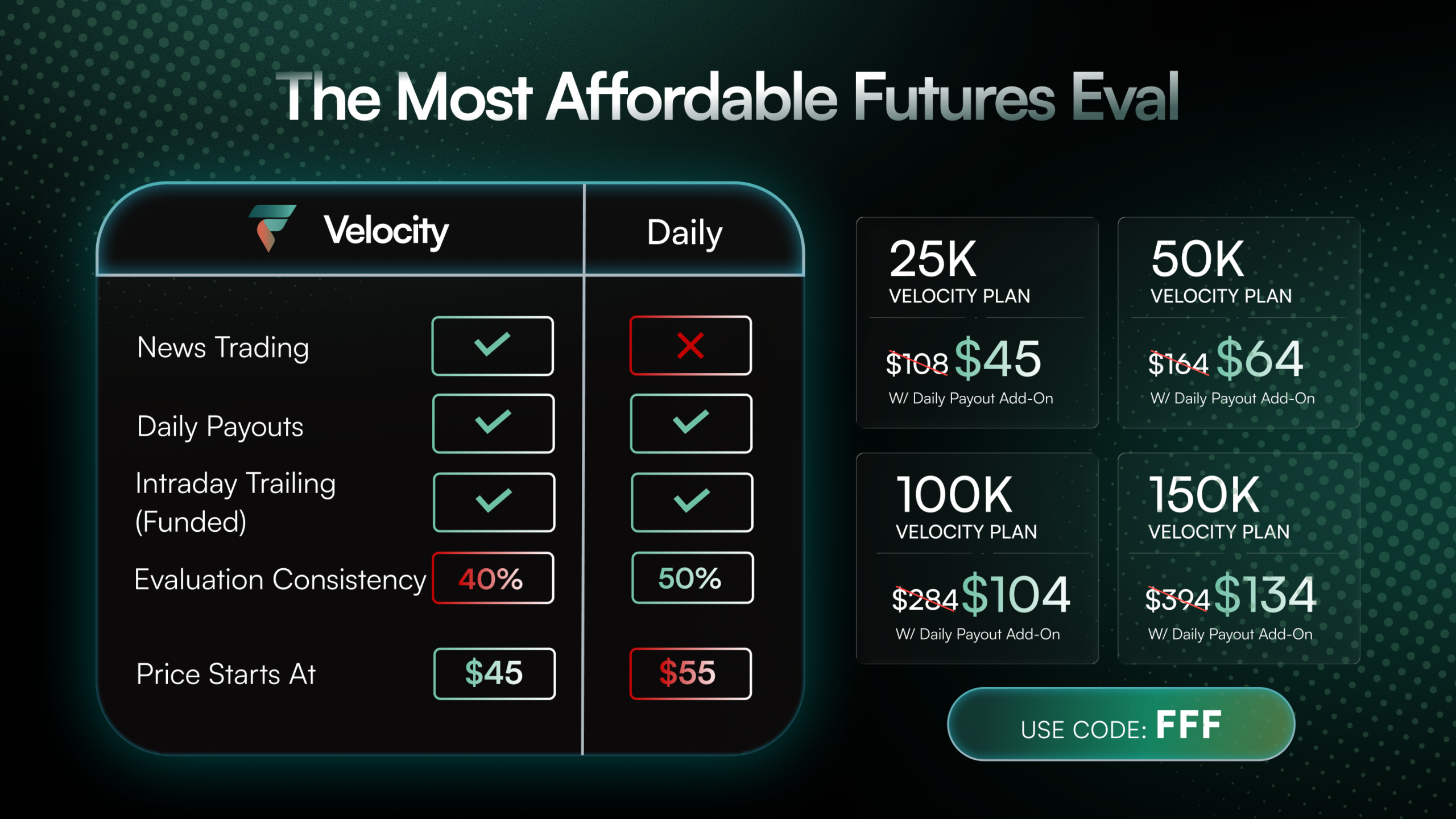
Facts checked August 16, 2026. FFF numbers come from the live Velocity plan page and help center. MyFundedFutures numbers come from myfundedfutures.com and their help center on the same date. Both firms change terms often, verify at checkout.
Short answer: Rapid is the plan MFF built its reputation on, daily payouts with no funded consistency rule, and it’s a strong product. It beats Velocity on the payout formula (no per-request cap above the buffer) and includes no-consistency by default, where Velocity charges $29–$69 a month for the add-on. Velocity answers with news trading allowed on the funded account (Rapid bans it), a funded account that starts at full balance instead of $0, and payouts that land within hours of an instant approval instead of after a manual review. Which one wins depends on whether you trade news and how you feel about MFF’s zero-start account structure.
The two plans in one table
| FFF Velocity + Daily Add-On | MFF Rapid | |
|---|---|---|
| Pricing (monthly) | With add-on: $108–$394 list; currently $45 / $64 / $104 / $134 with code FFF | $109 / $157 / $267 / $347 list; promos showed $55–$174 in August 2026 |
| Evaluation profit target | $2,500 / $4,000 / $7,000 / $10,000 | $1,500 / $3,000 / $6,000 / $9,000 |
| Evaluation consistency | 40%, minimum 3 trading days | 50% (evaluation only), minimum 2 trading days |
| Evaluation drawdown | Intraday trailing: $1,250 / $2,250 / $3,250 / $4,750 | End-of-Day trailing: $1,000 / $2,000 / $3,000 / $4,500, locks $100 above start |
| Funded account starts at | Full account balance | $0, balance can go negative before the trail reaches breakeven |
| Funded drawdown | Intraday trailing from balance | Intraday trailing from equity high-water mark; locks once the trail reaches $100 |
| Daily loss limit | None | None |
| Funded consistency | None with the add-on | None |
| News trading (funded) | Allowed, all releases | T1 news trading not allowed on the sim funded account |
| Payout gate | Profit requirement between payouts: $1,500 / $3,000 / $6,000 / $9,000 | One-time buffer of max loss + $100 ($1,100 / $2,100 / $3,100 / $4,600) |
| Payout frequency | Daily eligibility, no waiting period | Daily, every 24 hours; first available 24h after your first funded trade |
| Max per payout | $600 / $1,000 / $1,500 / $2,500 | No per-request cap listed; $500 minimum |
| Profit split | 90/10 from the first dollar | 90/10 |
| Payout processing | Instant approvals; funds in your Rise account within hours | Manual review, 6–12 business hours per their site (August 2026) |
| Live account path | Defined eligibility: $5,000+ in approved Professional Stage payouts, or an initial Pro payout with sustained consistency, subject to Live Desk review | By invitation only, at their sole discretion, via affiliated companies (their disclaimer) |
Sources: the Velocity page and FFF payout rules; MFF’s Rapid 25K/50K comprehensive guides and site disclosures, checked August 16, 2026.
Where MFF Rapid genuinely wins
The payout formula is simpler and more generous. Clear the buffer once (max loss plus $100) and every dollar above it is requestable daily with no per-request cap, just a $500 minimum. Velocity asks for a fresh profit requirement between payouts and caps each request at $600–$2,500. A trader who builds $4,000 of profit on a 50K can pull it in one request at MFF; at FFF that’s four capped requests across four cycles.
No-consistency also comes standard on Rapid’s funded stage. Velocity gets there only with the paid add-on. And Rapid’s evaluation is friendlier: lower targets, End-of-Day drawdown instead of an intraday trail, and a 2-day minimum against Velocity’s 3. MFF’s promo pricing ($55 for the 25K in August 2026) undercuts Velocity’s list price, though not its current $45 with code FFF.
Where Velocity pulls ahead
News trading, first and loudest. Rapid’s funded account prohibits T1 news trading; FFF allows every release on every plan. CPI and FOMC are some of the best sessions of the month for a lot of futures traders, and only one of these plans lets you keep trading them after you’re funded.
The account structure is the quieter difference. A Rapid sim funded account starts at $0 and the trail locks just $100 above zero, so early on you’re trading a thin line where a normal red day can end the account. Velocity’s funded account starts at the full balance with the trail measured from there. Both are intraday trailing; they feel very different in week one.
Then the money itself. FFF approvals are instant, with funds landing in your Rise account within hours. MFF reviews payouts manually, 6–12 business hours per their own site. And the endgame differs: FFF publishes concrete live-account criteria, while MFF’s disclaimer says live access is invitation-only at their sole discretion through affiliated companies. If a live account is part of your plan, read both firms’ fine print before choosing.
Which one fits you
Pick Rapid if you want the simplest daily-payout math in the business, don’t trade news, and are comfortable with the zero-start funded structure. Pick Velocity with the add-on if news sessions are part of your edge, you want your funded account to start at full balance, and same-day cash matters. The full firm-level comparison, with more of MFF’s plans covered, is at FFF vs MyFundedFutures. Real payout receipts are on the reviews page, and every FFF plan’s payout mechanics are on the payout speed page.

At checkout, code FFF currently prices Velocity with the add-on at $45–$134 a month, or first50 gets 50% off your first account plus a $250 bonus on your first payout.
Frequently asked questions
Do both plans really pay daily?
Yes, with different gates. Rapid allows a request every 24 hours once you’ve cleared the buffer (max loss + $100). Velocity’s add-on removes the waiting period entirely, but each request needs the profit requirement met since your last payout ($1,500 on a 25K). Neither has a funded consistency rule.
Can I trade news on Rapid or Velocity?
On Velocity, yes, FFF allows news trading on every plan, funded included. On Rapid, T1 news trading is not allowed on the sim funded account per MFF’s plan guides, even though their evaluations permit it.
Which pays out more per request?
MFF Rapid has no listed per-request cap above its buffer, with a $500 minimum. Velocity caps requests at $600–$2,500 by size but has no minimum and no buffer holding part of your balance back. Big single withdrawals favor MFF; fast small ones favor FFF.
How do the funded accounts differ structurally?
Rapid’s sim funded account starts at $0 with an intraday trail that locks at $100, so the balance can go negative before trailing to breakeven. Velocity’s funded account starts at the full account balance with the trail measured from your account value. Same drawdown type, very different early-account experience.
Ready to earn
with the Family?
Join Tier 1 in minutes, get your code, and start earning 10% on every evaluation you refer.