
Funding Ticks vs Funded Futures Family: Which Ruleset Fits Real Futures Traders?
Writer
Funded Futures Family Team

If you’re evaluating Funding Ticks, Top Step or Funded Futures Family (FFF), you’re already past the “marketing claims” stage—you’re trying to avoid the one thing that hurts most in prop trading: doing the work, getting profitable, then realizing the rules make payouts unpredictable. FFF positions itself around speed, transparency, and a repeatable path to withdrawals, including a defined “winning day” requirement and a clear consistency framework.
This page breaks down where FundingTicks and FFF tend to feel easy (when things go right), where traders commonly get stuck (when rules meet real volatility), and how to choose the model that best matches your trading behavior—not your wishful thinking.
What most traders actually want from a prop firm
Most futures traders aren’t looking for “the best prop firm.” They’re looking for:
- A ruleset they can follow without changing their strategy every week.
- A payout process that’s consistent enough to plan around (so trading can feel like a business).
- Clear definitions for qualifying days, profit splits, and what can get an account denied or closed.
FFF’s public messaging emphasizes “no hidden rules” and “full transparency,” and it explicitly defines how payouts are unlocked (plan-specific qualifying days with $200+ profit each) and how payouts are processed after approval.
How Funded Futures Family works
FFF’s process is built as a simple three-step path: pass the challenge, get funded, then get paid.
Step 1 — Pass the evaluation
FFF frames the evaluation as “hit your profit target without exceeding max loss,” and highlights that some plans can be passed in as little as 1–2 days depending on the plan.
Step 2 — Get funded fast (no activation fee messaging)
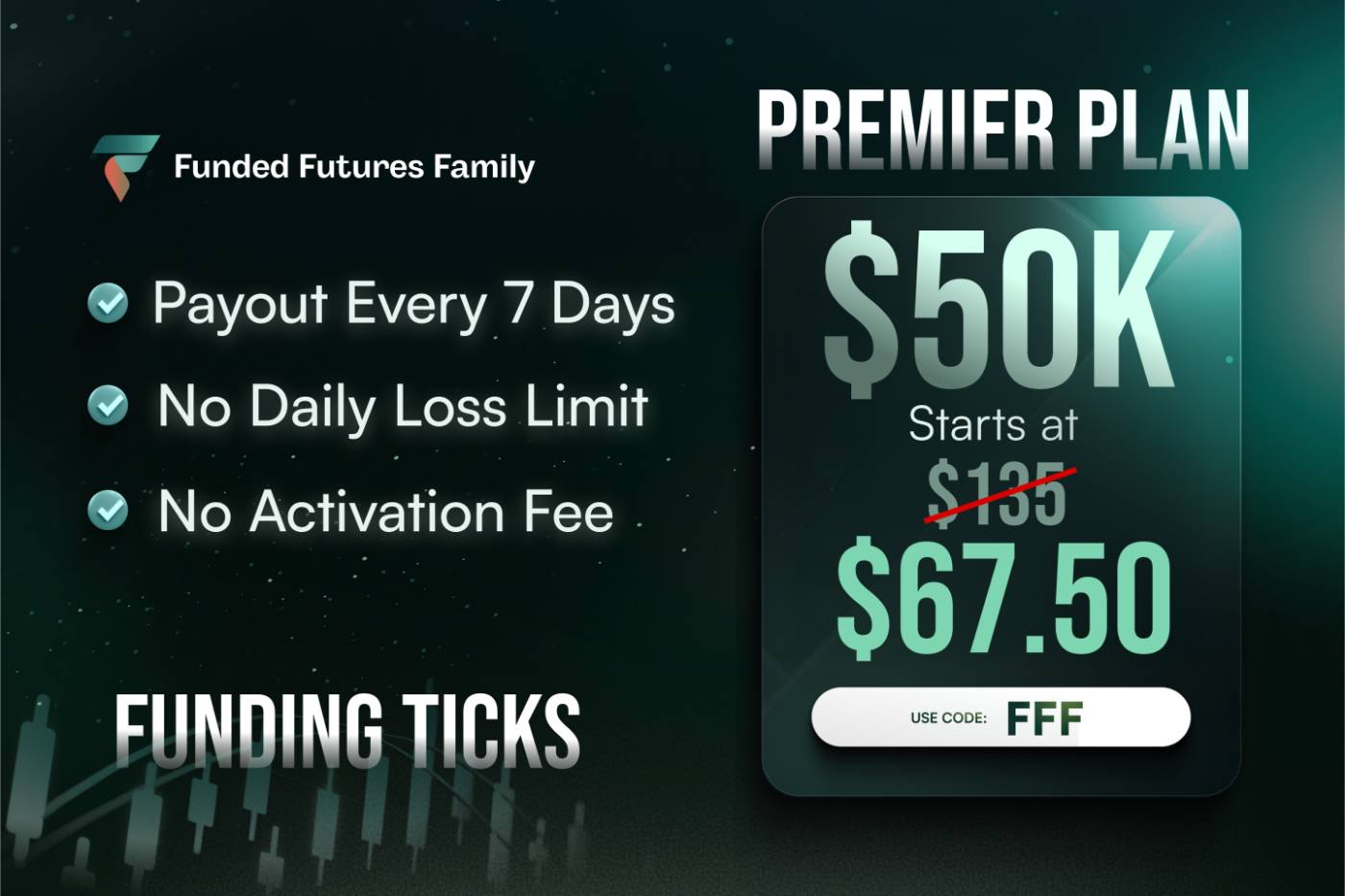
FFF states that passing the evaluation upgrades you to a funded account instantaneously, and it repeatedly markets $0 activation fee.
Step 3 — Qualify for payouts with repeatable rules
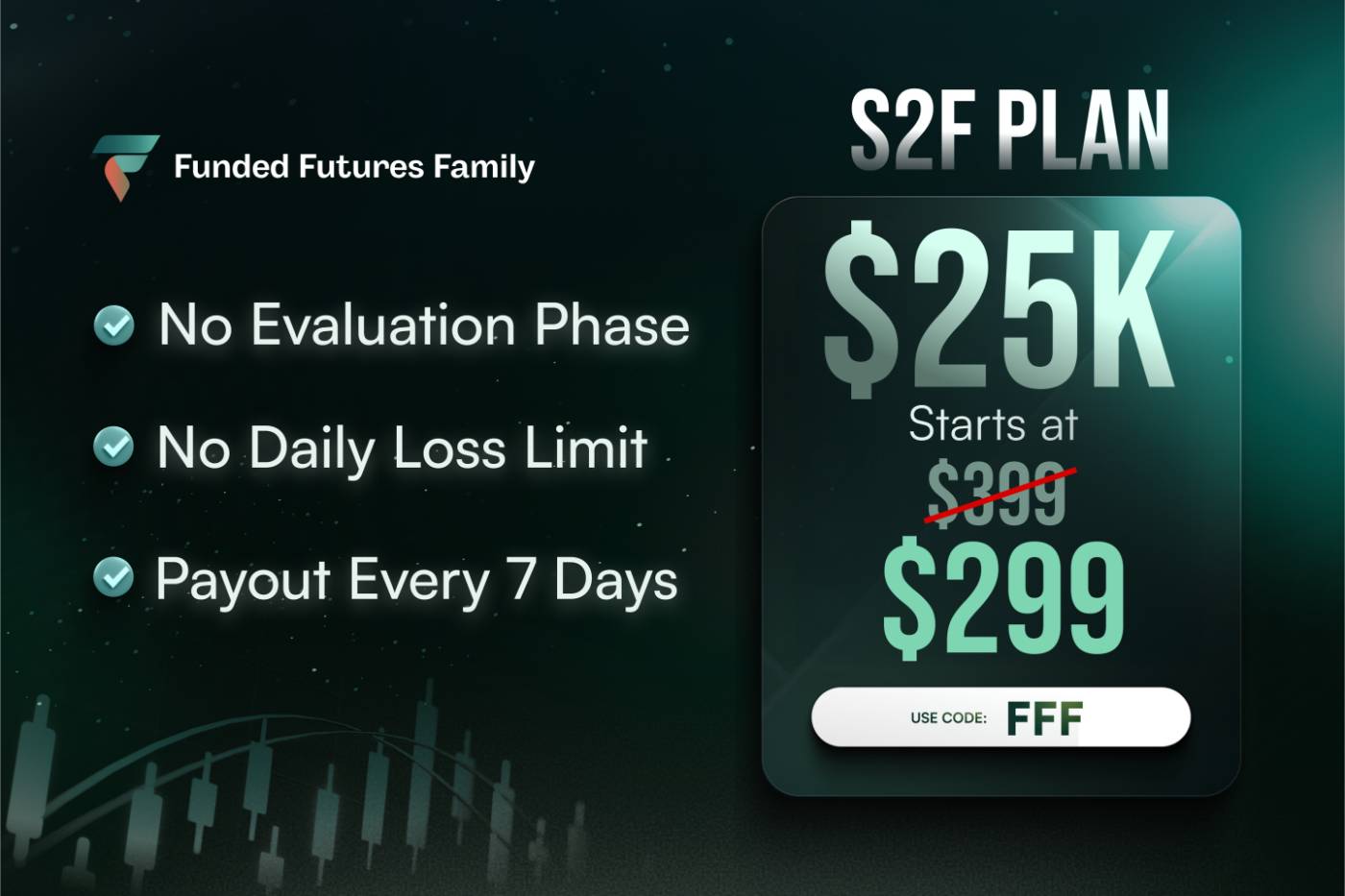
FFF states you qualify for payout after your plan’s minimum qualifying days on the funded account (3 on Prime and standard Velocity, 5 on Premier+, 7 on Straight to Funded), defining a qualifying day as $200+ profit. It also mentions a consistency rule framework tied to payout eligibility.
Payout timing and split (what traders care about)
FFF states “Verified Payouts” and promotes fast payout timing (including “24 hrs payout time” messaging on the site). It also markets “You keep 90%” profit split messaging, and states a flat 90/10 split on Prime and Premier+ in its payout requirements.
What “Funding Ticks” is known for (and what to watch)

FundingTicks is positioned as a futures prop firm with a simulated environment and real reward model, and it has substantial public visibility and discussion around rule enforcement and rule changes.
Rule-change controversy and payout anxiety risk
A major trader concern with FundingTicks in late 2025 was backlash tied to allegations of “retroactive rule changes,” including items like a minimum one-minute trade hold time and changes to profit split/withdrawal structure as described by Finance Magnates. Whether a trader agrees with the reasons or not, retroactive application is uniquely stressful because it changes the “deal” after trades are already placed.
Reputation signals
Trustpilot shows FundingTicks with a 2.9 rating at the time the page snapshot was captured, with a large volume of reviews and a high share of one-star ratings listed in the breakdown. Reviews also include repeated complaints about rules and payout processing, alongside some positive feedback—so the picture is mixed rather than one-sided.
The practical comparison: Where traders get stuck
The biggest difference isn’t who has better marketing—it’s where your strategy collides with the rules.
If you scalp or trade fast
If a firm enforces minimum trade durations or restricts sub-minute profits, scalpers can get trapped in “valid trade / invalid profit” situations depending on program rules. That creates a mismatch if your edge is speed-based execution rather than swing follow-through.
If your P&L has “big days”
Some prop models penalize you for one standout day via consistency caps, which forces you to keep trading just to make the large day become a smaller percentage of total profits. FFF’s approach is built around stacking qualifying days ($+) and keeping risk contained under max loss—so a trader who can reliably print modest green days may find the pathway easier to manage.
If you hate uncertainty more than you hate rules
FundingTicks has faced public criticism for rule-change handling, which increases perceived “payout approval risk” even for traders who follow rules carefully. FFF leans into predictability: it clearly defines winning days and positions payouts as repeatable once you learn the framework.
Who should choose Funded Futures Family
FFF tends to be a better fit when the trader values repeatability over “home run” trading days.
- Traders who can stack controlled $200+ days and stop trading once the day is done align naturally with FFF’s qualifying-day requirements.
- Traders who want a simple mental model—profit target vs max loss in eval, then the plan’s qualifying days once funded—may prefer FFF’s structure over firms where rules feel like moving parts.
- Traders who care about fees often notice the $0 activation fee positioning and the 90% profit split messaging.
To make this even clearer: your best fit is the firm whose rules you can follow on your worst trading week, not your best one.
FAQ
Ready to earn
with the Family?
Join Tier 1 in minutes, get your code, and start earning 10% on every evaluation you refer.